
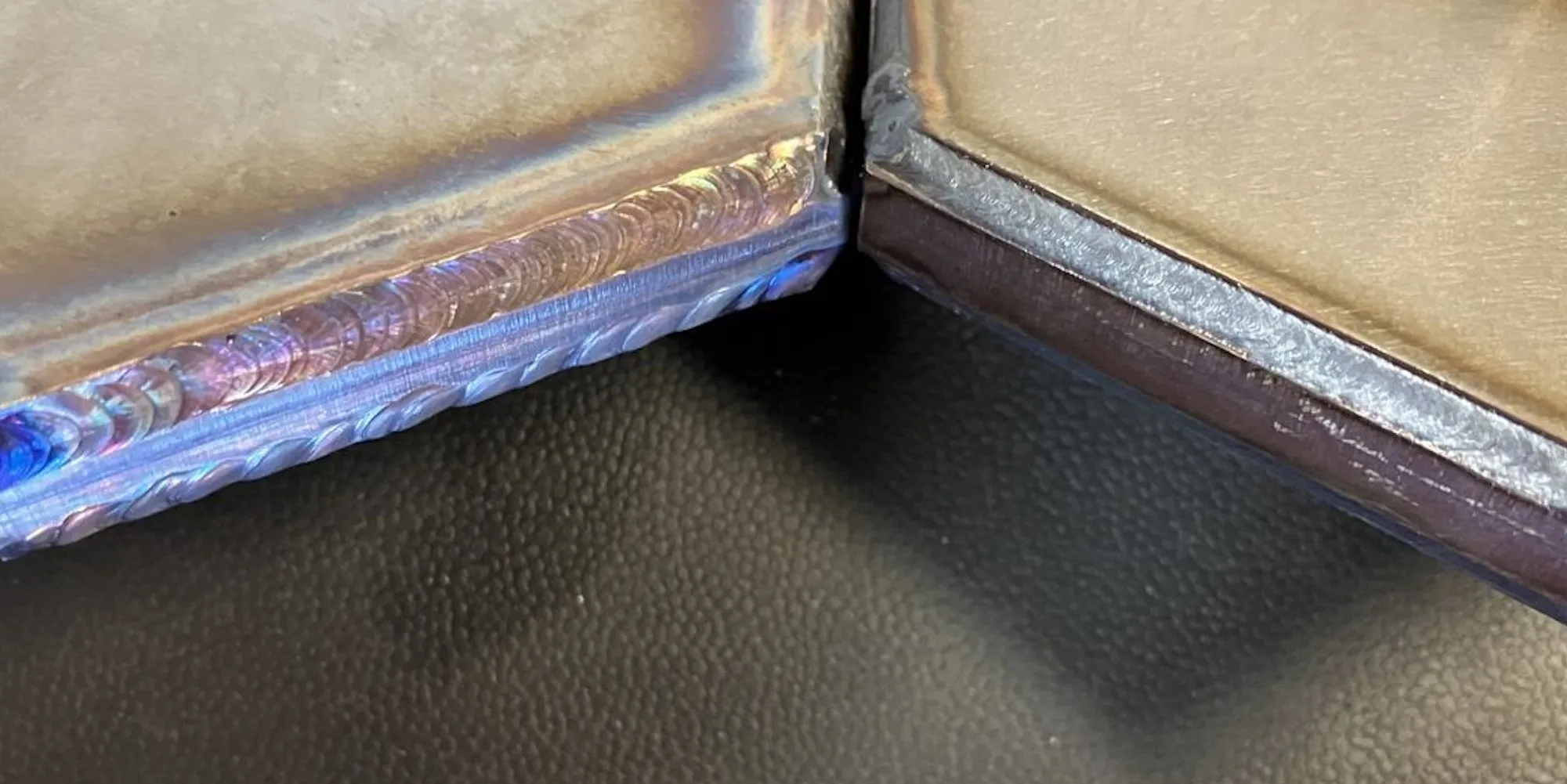
After recently running my first beads with a handheld laser welder, I wanted to evaluate it through the lens of a TIG and stick welding background. The conclusion is clear: laser welding will play a significant role in the future of fabrication. However, in precision welding applications, it is better understood as a complementary process, not a replacement for TIG.
Key observations
- Heat input. Laser welding introduces significantly lower heat input than TIG, reducing the size of the heat-affected zone and expanding possibilities for thin or heat-sensitive materials.
- Distortion. Reduced heat input can minimize distortion, but it does not eliminate it. Solidification shrinkage and residual stresses remain governing factors.
- Travel speed. Laser welding enables substantially higher travel speeds, a clear advantage in production environments.
- Process forgiveness. This is a critical distinction. Laser welding is far less forgiving than TIG. Minor deviations in fit-up, travel, or alignment are immediately reflected in the weld.
- Shielding. Gas coverage appeared less robust in initial use, which may present challenges with reactive alloys.
- Operator skill transfer. The physical technique differs, but foundational knowledge of heat control, metallurgy, and weld behavior remains highly relevant.
Insights from industry discussion
- Fit-up and preparation become more critical with laser processes
- TIG remains advantageous in less controlled or variable conditions
- Skill requirements shift rather than diminish
Final perspective
Laser welding represents a meaningful advancement in capability, particularly in controlled, high-efficiency environments. TIG welding continues to offer unmatched adaptability and control in precision work.
The future of welding is not one process replacing another, but the strategic integration of both.