
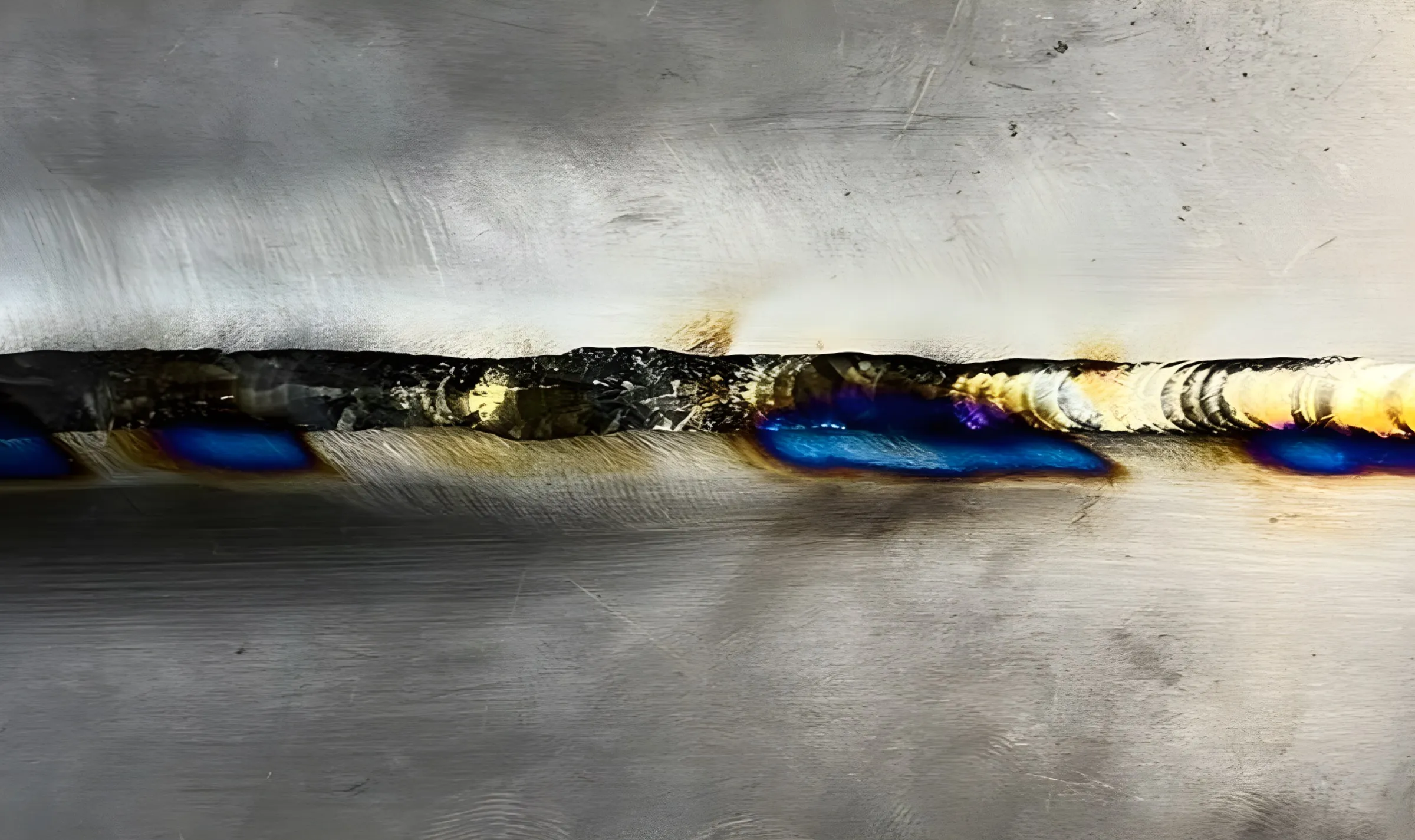
Titanium welding is often described as unforgiving, and for good reason. Even small deviations in technique or shielding can lead to defects that immediately disqualify a weld from strict aerospace standards. One of the most common, and most visually obvious, failures appears as colorful discoloration across the weld surface.
At first glance the weld may look almost beautiful, with purple and blue tones shimmering across the bead. In reality, those colors are a clear sign that the weld has already failed inspection.
When color means failure
In a recent weld test, a titanium coupon was evaluated under AWS D17.1 Class A, the standard typically applied to flight-critical aerospace hardware. It was rejected immediately during visual inspection due to purple and blue discoloration on the weld surface.
Discoloration indicates that the molten weld pool was exposed to atmospheric impurities such as oxygen or nitrogen. Titanium has an extremely high affinity for these elements at elevated temperatures. Contamination leads to embrittlement: tensile strength increases while ductility decreases. The weld becomes stronger but significantly more brittle, increasing the risk of catastrophic failure under stress.
The strict reality of AWS D17.1 Class A
D17.1 Class A is among the most demanding welding standards, intended for components where failure could have severe consequences. Even minor visual imperfections can result in immediate rejection. Welds like this one might still pass destructive mechanical testing or radiographic inspection. But for flight-critical hardware, visual indicators of contamination alone are enough to disqualify the weld.
In aerospace manufacturing, the standard is not "good enough." It is zero tolerance for uncertainty.
Discipline over talent
Meeting D17.1 Class A does not require superhuman welding ability. It comes down to discipline, repeatable processes, and strong process control. Factors to control:
- Torch consumables
- Shielding gas flow rate and purity
- Tungsten stick-out
- Torch angle and travel speed
- Cleanliness of the weld joint
- Weld output parameters
Small adjustments, big results
After evaluating the process, the welder only needed minor adjustments to travel speed and torch angle. The next sample passed both destructive and non-destructive testing under AWS D17.1 Class A.
The role of a strong quality management system
- Identify the variables.
- Measure them.
- Control them.
- Adjust when necessary.
Done correctly, even AWS D17.1 Class A becomes manageable. Sometimes the difference between a failed titanium weld and a flight-ready one is a slight adjustment to torch angle and travel speed.